desk/
Two ways to keep the decision desk (docs/desk.md): a static page, or GitHub
Issues (github-issues.md).
The static page
index.html renders desk.json: one HTML file, inline CSS and JavaScript, no
framework, no build, no server. It shows each card’s title, why it waits,
context, steps, texts to paste (whole, each with a copy button), choices
(the recommended one marked), links, answer, status and resolution, grouped
as waiting on you, answered and done. It works at phone width and has
light and dark themes (the system’s, or chosen with the Theme button).
- Where it reads from. Served over HTTP (any static host, or
python3 -m http.serverin this directory), it loadsdesk.json, elsedesk.example.json, or the file named by?src=. Opened straight from disk (file://), the browser does not let a page read files next to it, so the page asks for the file: Open a desk file, or drop it on the page. - Every card is checked before it is shown. A card that does not fit the schema is shown at the top as malformed, naming the field and holding its raw JSON, never dropped or half-rendered.
- Several questions in one card render as rows of pills, the key in
monospace and the recommended option marked. The answer’s note is composed
as one
<id> <key>line per answered question, then the free text; a live preview shows what goes to the coordinator. - Quoting. On an open card, each context paragraph has a “↩” button (on
hover, or always on touch screens) that adds
<ID>:to the answer when the paragraph starts with an id (Q3,ABC-12,wc-3.1), else a quote of up to 80 characters and ` — `. - A glossary. Terms, epics and abbreviations from the desk’s
glossary, and ids matching itsidPattern, are underlined and explained in a tooltip on hover, focus or tap. - Nothing becomes HTML. The page builds every node with
createElementand puts every text in as text, glossary summaries included. - The format is
desk.schema.json;desk.example.jsonhas four cards (an environment to create, three questions in one card, a decision with choices, a question answered with a note) and a glossary with an alias and an id pattern.
| Phone, light | Phone, dark, and a malformed card | Desktop, dark, a term explained |
|---|---|---|
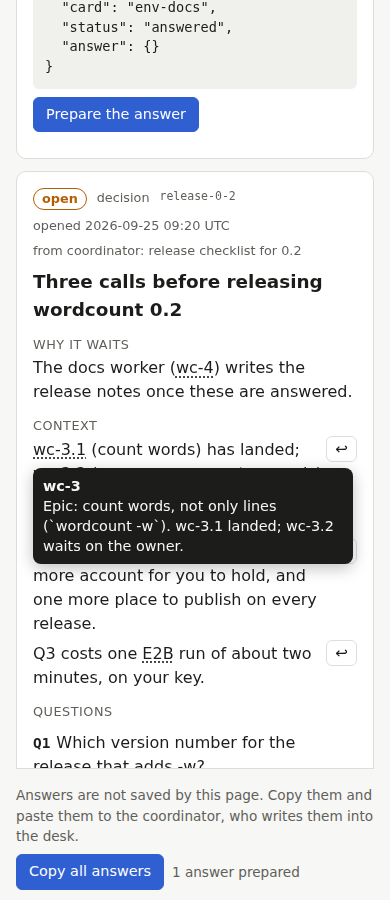 |
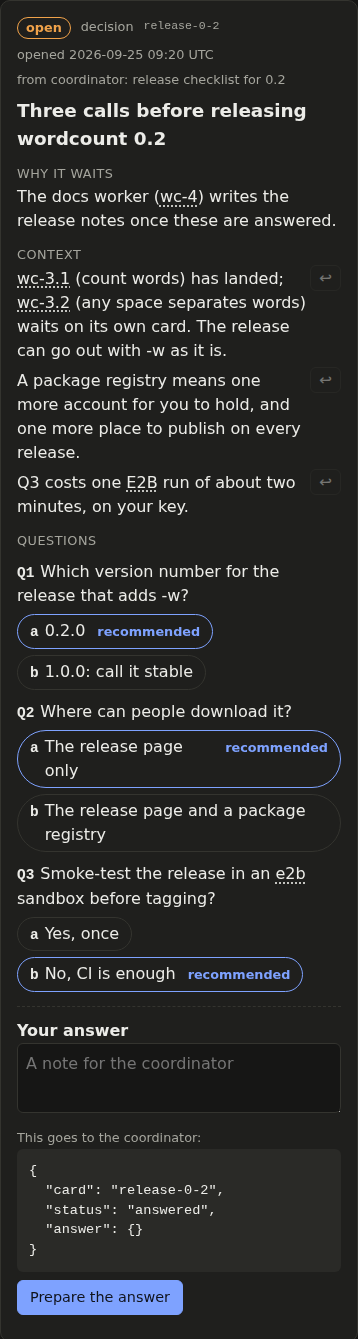 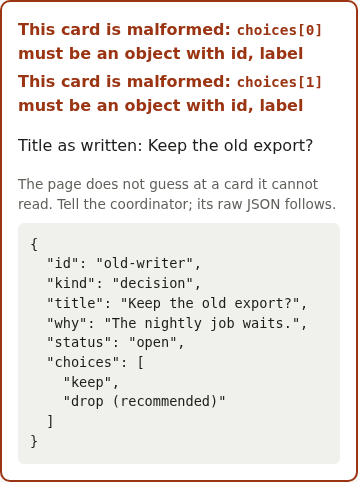 |
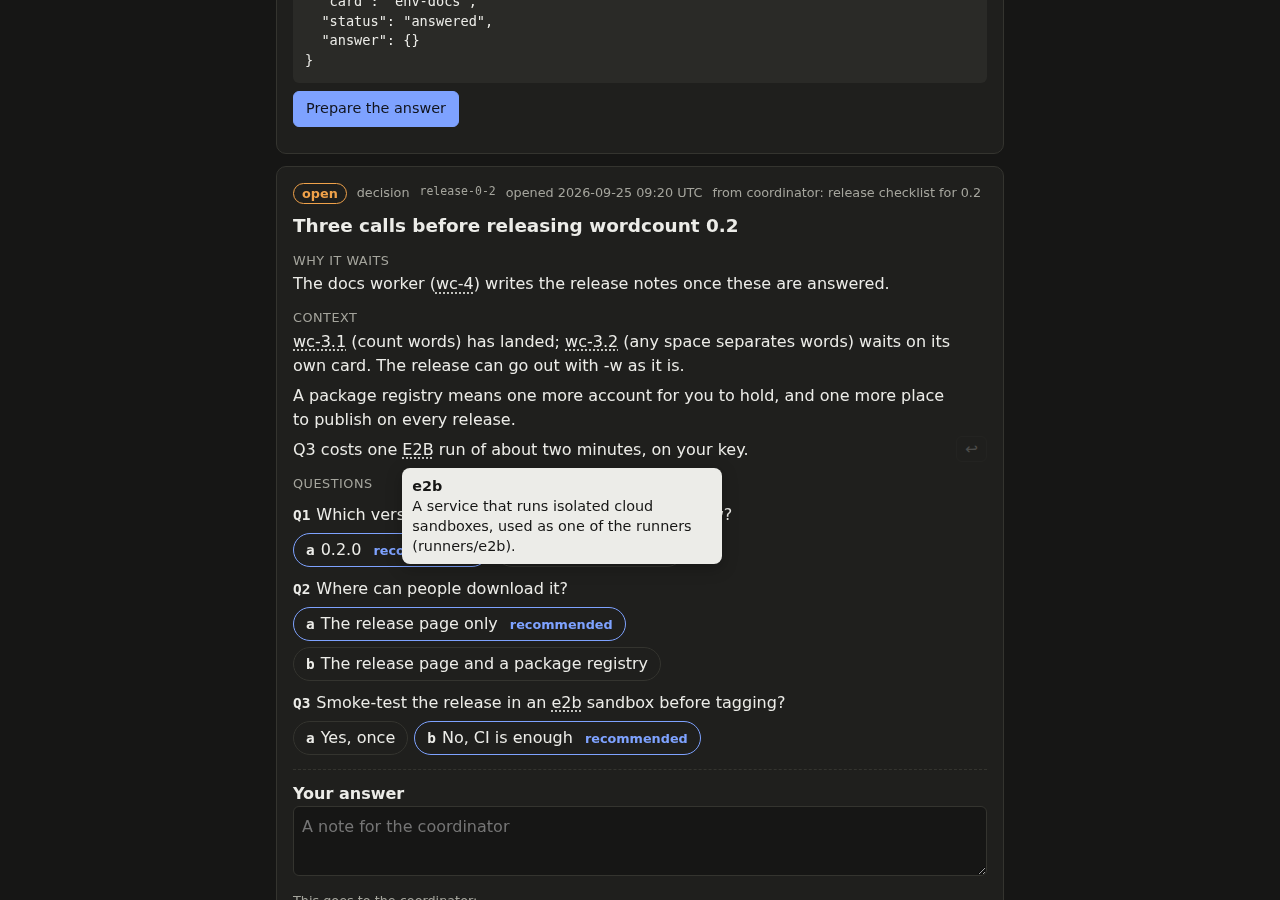 |
Answers: a snippet to paste, not a file to download
A static page cannot write desk.json. The page could offer the owner a new
desk.json to download, or a snippet to copy. It gives the snippet:
{
  "card": "wc-3-unicode",
  "status": "answered",
  "answer": { "choice": "unicode-spaces", "note": "…", "at": "2026-09-25T09:32:00.000Z" }
}
The owner pastes it to the coordinator (one card, or Copy all answers),
and the coordinator writes it into desk.json. Why not a download:
- One writer. The coordinator is the only writer of the desk, as of the
tracker. A downloaded
desk.jsonis a second copy of the whole queue, made from whatever version the page loaded; putting it back would overwrite cards the coordinator added or closed since. - The answer is data. A snippet names one card and carries only
{choice, note, at}. The coordinator applies it within the question asked and nothing else; a whole file would make it diff the queue to find out what the owner changed. - It fits the channel. The owner already talks to the coordinator in chat; pasting there needs no file handling on a phone.
Checks
tests/desk.test.mjs (node --test, no dependencies) runs the page’s own
script against a minimal DOM whose innerHTML throws, and checks: the example
renders without problems and shows every field of the schema; a malformed card
is shown with its field and raw JSON; the page’s card check agrees with
jsonschema on every card in tests/fixtures/desk/cards/; the note composed
from questions; the quote line with and without a leading id; glossary
wrapping (longest match, no match inside a word, aliases, the id pattern) and
that a <script> in a summary stays text. tests/examples.bats checks
the example against the schema.
The page was also driven in Chromium (2026-09-25, not part of make check):
the example renders at 375 px wide without horizontal scrolling, in light and
dark; preparing an answer shows the snippet; opened from file://, it asks
for the file and renders it once chosen. The only console message was the
expected 404 for desk.json before falling back to the example.